

Robinhood's official entry into the crypto market is an exciting development for the ecosystem. Howeveer, it’s not the only big player to launch its own chain recently. Circle’s Arc and Tempo have also entered the market, and Monad, the Canton chain, and other newer chains are still looking to make their mark. All of these newly launched blockchains seem to say that they looked at other ecosystems and realized that there is a gap. Recently, Vlad was asked why they built their own chain, and he said the same thing!

Robinhood Chain was built in collaboration with various players, including Offchain Labs, the developers of Arbitrum, being the major partners. This year, I attended invite-only events in NYC and London, organized by Arbitrum and sponsored by Robinhood, to encourage developers to build in their ecosystem. Full disclosure, CanHav Research has recieved grant funding from Arbitrum as well.
I think enough time has passed that we can look at the first few months of Robinhood Chain to analyze performance and study the numbers behind traction, on-chain usage, and funding for projects being built in this space.
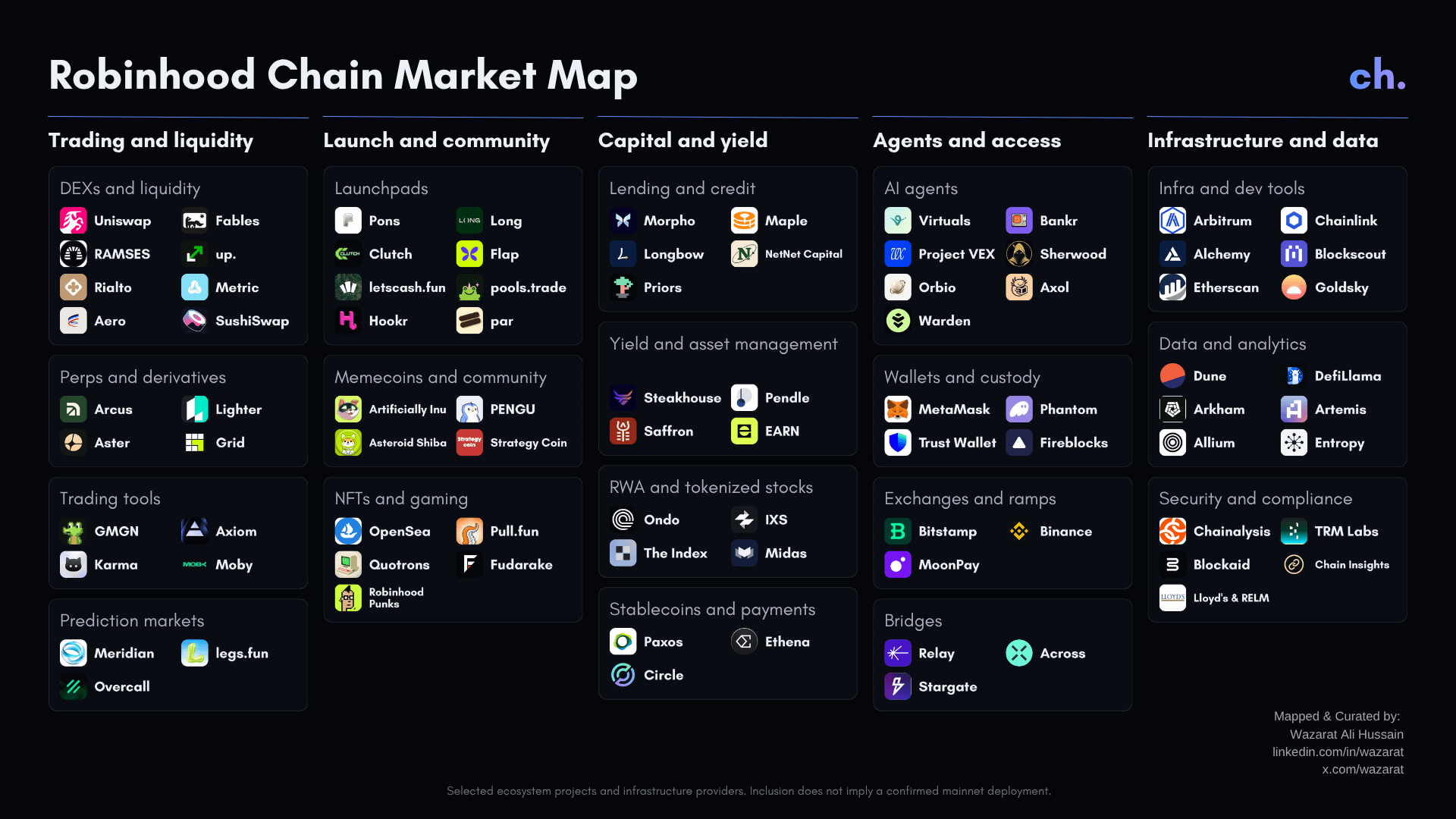
For my research, I’ve compiled over 600 projects across 19 categories, including new/smaller projects as well as bigger players that have joined the ecosystem.
Across hundreds of projects on Robinhood Chain, a small group dominates economic activity. Established projects were expected to bring most of the capital, but some native projects have captured a disproportionate share of revenue too.
This article offers a comprehensive look at what the data shows.
For the full dataset used for the market map and the analysis in this article, visit: robinhood.canhav.com
What has been built?
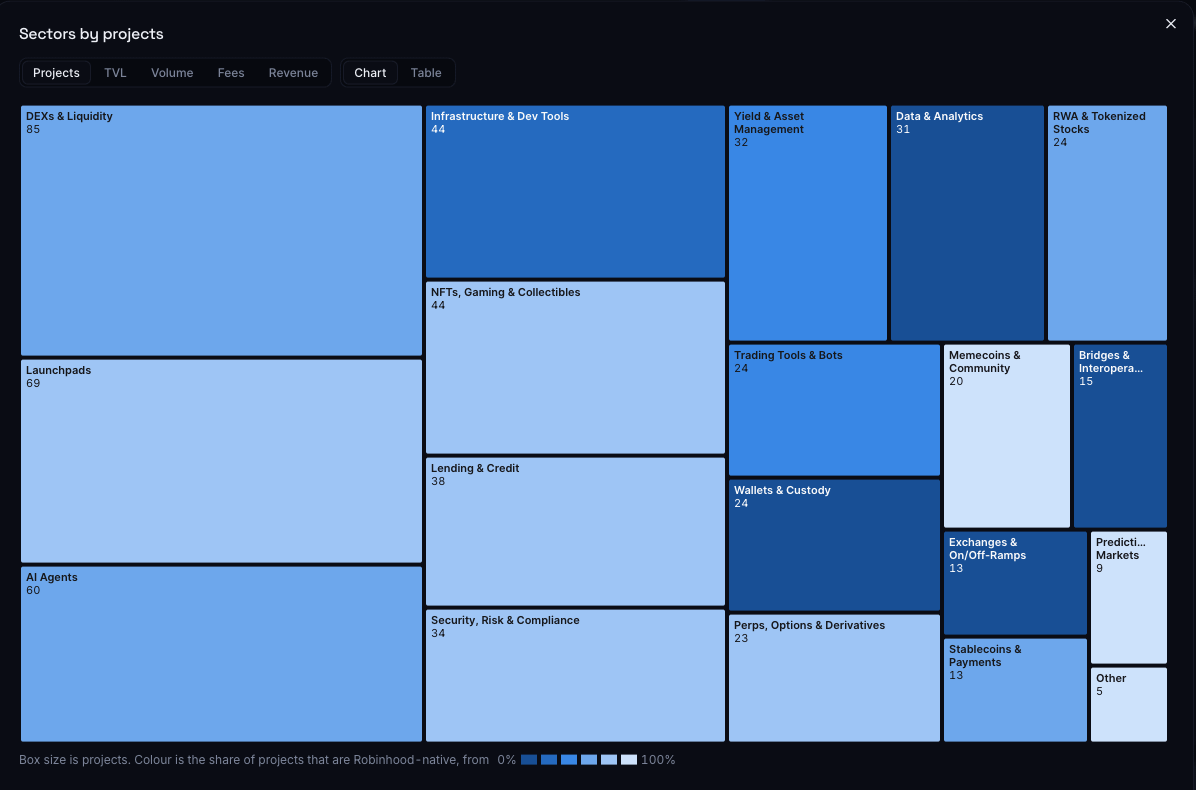
The 607 projects I’ve identified span DeFi, trading infrastructure, AI agents, tokenized assets, gaming, and more.
The three largest categories are DEXs & Liquidity, Launchpads, and AI Agents. Together, these represent approximately 35% of the projects I’ve mapped.
Established protocols and applications from other blockchains have expanded to Robinhood Chain, alongside new teams building directly on the network. From prediction markets and memecoins to lending protocols and perpetual exchanges, many of the same applications we’ve seen across crypto are now appearing here too.
This raises an important question: How much of this development represents genuinely new products or a unique value proposition? Also, how much is the expansion of existing crypto business models onto another chain?
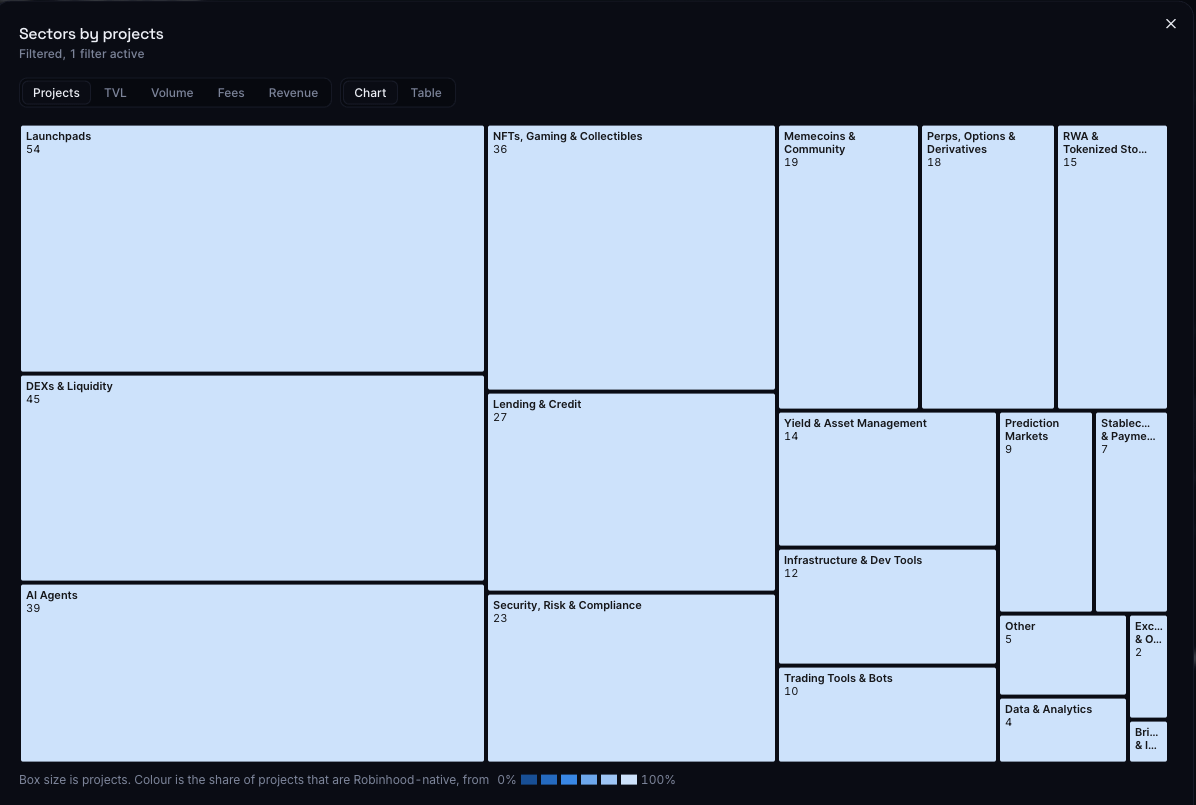
The above distribution shows Robinhood Chain Native projects. For a very new blockchain, there are a significant number of projects built natively on Robinhood Chain. I believe this is due to their focus on reaching out to developers through buildathons and in-house events in collaboration with Arbitrum. It also helps that they’ve committed $1M in funding. The promise of funding through grants and prizes is an attractive proposition for DeFi builders.
I first learned about Robinhood Chain at the Arbitrum Founder House event, where they invited developers across the DeFi space to an in-person Founder House event in New York City in March. Robinhood Chain’s goals and ambitions were introduced before the mainnet launch, with members of the Robinhood Chain team present to help builders develop.
I believe initiatives to engage these developers are a major reason Robinhood Chain has so many native projects.
I also see two other potential factors:
Robinhood’s established retail trading brand. Robinhood built its reputation by making investing more accessible to retail users. While traditional brokerage customers and crypto-native traders aren’t identical audiences, there is some overlap in their interest in accessible, low-friction trading. For developers, Robinhood’s brand and potential distribution network are attractive, even if that doesn’t guarantee access to its existing customers.
The appeal of crypto-native trading culture. Robinhood Chain’s permissionless environment has attracted launchpads and speculative trading applications, including projects such as Pons. These applications can generate activity quickly, but they also introduce risks associated with speculative tokens, short-lived projects, and potential scams.
Beyond the chain itself, Robinhood has also expanded its international crypto presence through acquisitions such as Bitstamp and WonderFi. While these acquisitions don’t directly establish Robinhood Chain adoption, they strengthen the broader financial ecosystem Robinhood is building.
Robinhood appears to have been successful at attracting developers. However, we’ve seen with other similar chains, attracting developers and attracting users are two very different things.
The more important question is whether these projects are finding real traction, generating economic activity, and creating products people want to use.
That’s where the onchain data becomes particularly interesting.
Who’s actually getting traction?
While Robinhood Chain has attracted hundreds of projects across different sectors, attracting developers doesn’t necessarily translate into attracting users or capital.
Looking at the onchain data, economic activity is heavily concentrated among a handful of established protocols.
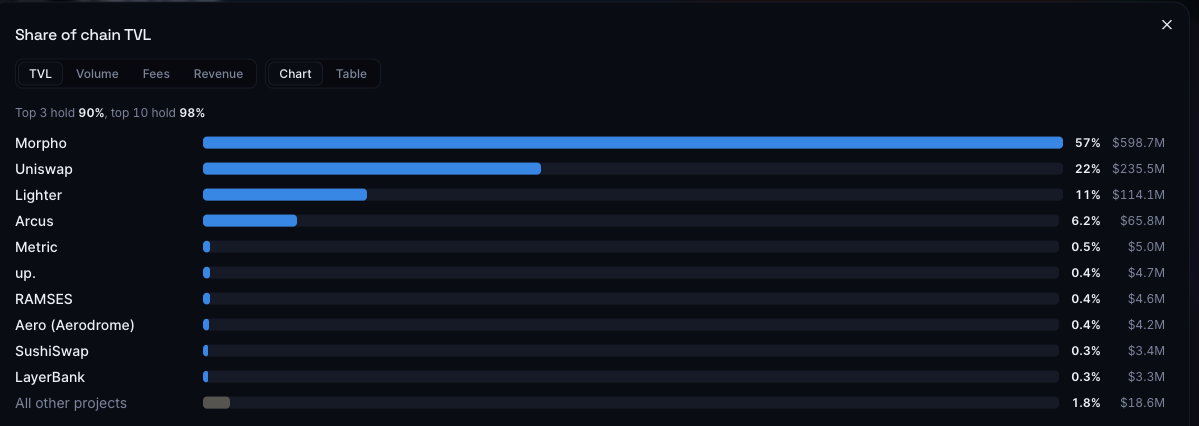
Morpho is the clear leader in Total Value Locked (TVL), holding almost $600 million, or 57% of the chain’s tracked TVL. Uniswap follows with approximately $235 million (22%), while Lighter holds around $114 million (11%).
Together, these three protocols account for approximately 90% of Robinhood Chain’s TVL, with the top ten accounting for 98% as of November 10th, 2026.
I find Morpho’s dominance to be interesting because with they have comptetition in the lending space with the likes of Aave. In my research in CanHav, I found most of Morpho’s liquidity is associated with USDG lending infrastructure, including the vault curated by Steakhouse and accessible through Robinhood Earn. This demonstrates the potential advantage of established protocols integrating with Robinhood’s existing financial services ecosystem.
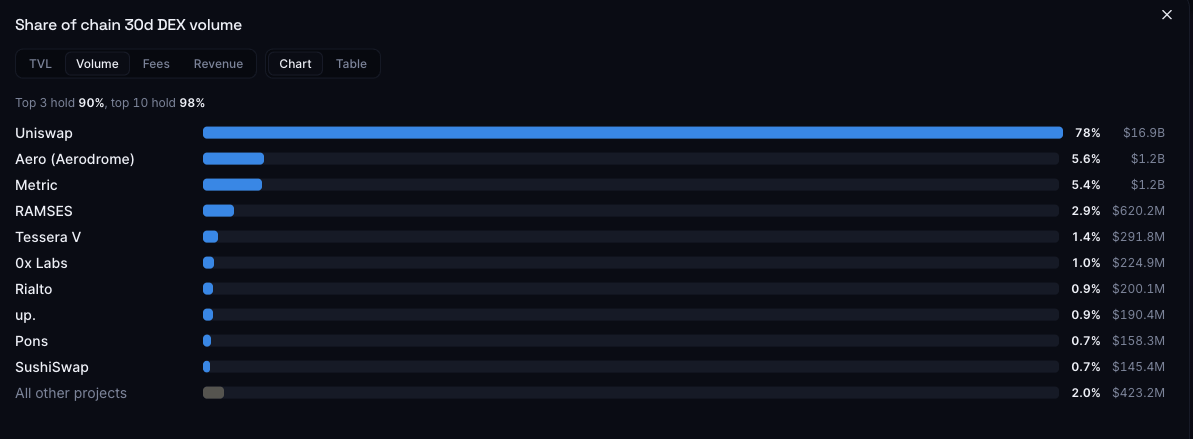
Analyzing the trading activity, it’s a similar story. Uniswap dominates decentralized exchange volume, accounting for approximately 75% of DEX trading activity in my dataset.
This is unsurprising given Uniswap’s established liquidity infrastructure and market presence. The popularity of token launches and speculative trading applications may also be contributing to this activity, although identifying exactly how much volume originates from launchpads requires a closer examination of trading pairs.
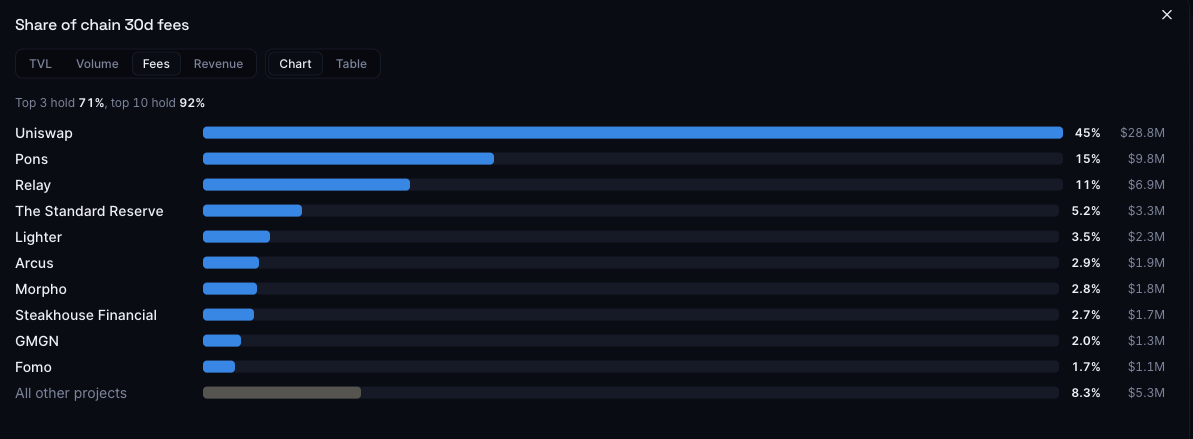
When looking at fees generated over the last 30 days, Uniswap leads again with approximately $28.8 million, representing 45% of tracked fees.
However, Robinhood-native applications are also beginning to establish themselves. Pons generated approximately $9.8 million in fees (15%), while Relay followed with $6.9 million (11%). Together, these three applications accounted for 71% of fees across the tracked ecosystem.
Analyzing this data also helped me understand that applications attracting the most capital aren’t necessarily those generating the most fees or retaining the most revenue.
The data suggests that established protocols are currently winning the battle for liquidity and trading volume, while some Robinhood-native applications are successfully monetizing the activity surrounding them.
However, this concentration also raises a question about the rest of the ecosystem. Can the hundreds of smaller projects attract meaningful usage, or will activity continue to be dominated by a handful of market leaders?
And for the developers building these applications (like myself), there’s another question worth exploring: where is the funding actually coming from?
Where is the capital really coming from?
Funding across Robinhood Chain comes from a mix of venture capital, token launches, grants, corporate backing, and founders financing their own development.
Of the 607 projects I’ve mapped, 270 have an identifiable funding model. VC-backed projects represent the largest category at 42%, followed by token-funded projects (18%), bootstrapped teams (15%), and grant-supported projects (7%). Another 6% operate with token or DAO treasuries.
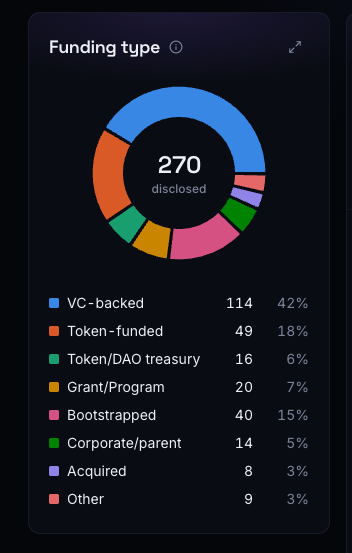
However, there’s an important distinction between established VC-backed companies expanding to Robinhood Chain and native teams raising capital specifically to build on the network. Much of the venture funding I’ve identified belongs to established projects whose investment rounds predate their expansion to Robinhood Chain. Publicly disclosed VC funding for Robinhood-native startups appears considerably more limited.
Robinhood and Arbitrum have helped bridge this gap through ecosystem incentives. This includes Robinhood committing $1 million to the Arbitrum Open House program. CanHav Research has also benefited from ecosystem funding, so I’ve experienced firsthand how these initiatives can encourage developers to participate.
Beyond grants, Robinhood has deployed significant capital into its broader financial ecosystem through acquisitions, including Bitstamp in 2025 and WonderFi in 2026. These acquisitions expand Robinhood’s international crypto infrastructure and customer base, although they should be distinguished from direct investments into Robinhood Chain projects.
In the absense of capital and VC funding, our data shows that projects have turned towards raising funds through tokens.
Rather than relying exclusively on venture investors, native projects can launch tokens, attract liquidity, and potentially fund development through token allocations and protocol-generated revenue. Personally, I was of the belief that ICOs and token launches were no longer relevant in 2026. However, looking at the data, many smaller projects continue to find their niche and raise funds through this method!
Longbow, for example, launched its BOW token through Pons, demonstrating how launchpads can help emerging projects establish a market for their tokens. In another development, Uniswap Labs purchased PONS tokens in September 2026, signalling strategic interest in one of Robinhood Chain’s leading native applications. This was a token purchase, not an acquisition of the Pons platform.
These developments highlight an interesting difference between traditional startup financing and crypto-native capital formation. While established protocols often arrive with years of venture backing, newer teams have access to grants, bootstrapping, token launches, and revenue-driven growth.
The question is whether these alternative funding models can support sustainable businesses once the initial excitement and trading activity begin to settle.
Who’s winning?
So far, many of the biggest players on Robinhood Chain are established protocols that have already built a presence on other blockchains.
This isn’t particularly surprising. Many of the use cases Robinhood Chain is focused on, including tokenized equities, lending, and decentralized trading, have already been explored across other ecosystems. Established protocols bring existing infrastructure, liquidity, users, and market credibility, giving them a considerable advantage when expanding to a new chain.
Uniswap alone accounts for approximately 75% of DEX trading volume, while Morpho has emerged as one of the largest destinations for lending liquidity.
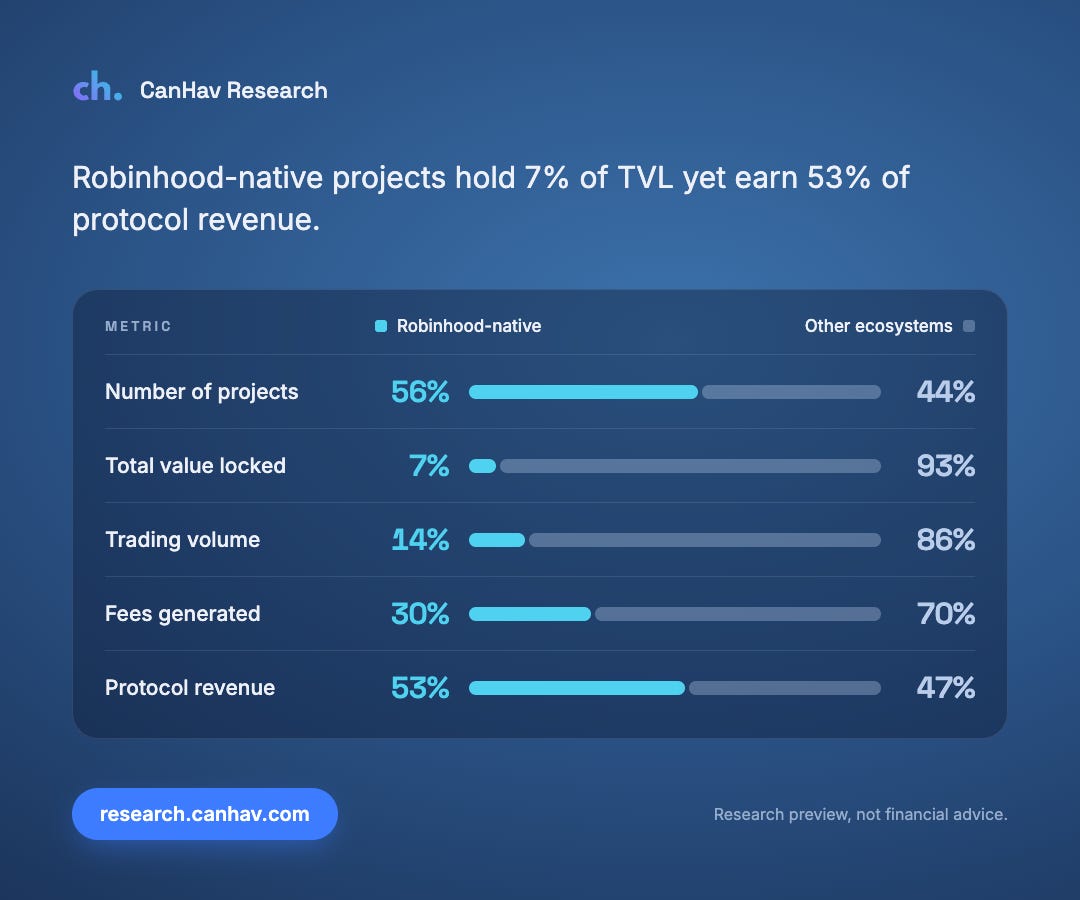
However, what’s interesting is that Robinhood-native projects account for 56% of the projects I’ve mapped, but only 7% of tracked TVL and 14% of trading volume. Despite this, they generate approximately 30% of fees and 53% of protocol revenue.
This suggests that while established protocols attract most of the capital, native projects are finding ways to capture economic value.
Pons, the Robinhood-native launchpad generated approximately $11.2 million in fees over 30 days, establishing itself as one of the ecosystem’s leading applications. Other native projects, including The Standard Reserve, have also demonstrated meaningful revenue generation.
However, growth hasn’t come without problems. Several early projects have shut down, while others have faced allegations of scams and questionable token launches. These incidents highlight the risks of an ecosystem where new applications can emerge and attract substantial capital in a relatively short period.
For Robinhood-native projects, the challenge is therefore twofold: attracting users and liquidity while building the trust required to retain them. This is probably a challenge faced by the entire industry after the Binance hack, but gaining trust for a smaller team in this space is a significant hurdle.
Established protocols have the advantage of experience and existing market relationships. Native teams have the opportunity to create products specifically designed for Robinhood Chain’s ecosystem, but they’ll need to demonstrate that their success extends beyond initial token launches and speculative trading activity.
Ultimately, the winners won’t necessarily be the projects attracting the most capital today, but those that can turn early traction into sustainable businesses.
Which business models are gaining the most traction?
Looking at the data, three business models stand out on Robinhood Chain: decentralized exchanges (DEXs), lending and yield protocols, and launchpads. However, each attracts capital and generates revenue in very different ways.
DEXs dominate trading activity. Over the last 30 days, DEXs and liquidity protocols generated approximately $23.65 billion in trading volume and $39.6 million in fees. Uniswap alone accounted for $18 billion of that volume, representing roughly 75% of the sector. Other players, including Fables and Metric, each recorded more than $1.1 billion in trading volume.
Lending and yield protocols attract the most capital. Morpho and Steakhouse report approximately $610 million and $535 million in TVL, respectively. However, much of this represents the same underlying capital, particularly the USDG vault curated by Steakhouse on Morpho. Robinhood Earn also provides users access to yield through this infrastructure. This highlights how Robinhood’s existing distribution channels can potentially help attract liquidity to its blockchain ecosystem.
Launchpads, meanwhile, have emerged as significant fee generators. Pons generated approximately $11.2 million in fees over 30 days, making it one of the most successful Robinhood-native applications. Other business models, particularly perpetual exchanges and reserve-based protocols, have also demonstrated traction. The Standard Reserve, for example, generated approximately $3.3 million in protocol revenue over the same period.
For developers and startup founders crafting a business model, it’s important to understand that the protocols generating the most fees aren’t necessarily the ones retaining the most revenue.
Uniswap retains approximately 5% of its reported fees as protocol revenue, compared with around 15% for Pons and more than 90% for certain other protocols, including The Standard Reserve and Lighter.
Thus, while high TVL shows where capital is deposited, if your business model depends on trading activity, then that’s the metric which might be more important. Perhaps protocol revenue offers a better indication of how effectively a business model captures economic value.
Ultimately, Robinhood Chain’s leading business models are succeeding in different ways: lending attracts capital, DEXs generate trading volume, and launchpads and other trading applications capture meaningful revenue.
Is Robinhood Chain becoming a tokenized-stock ecosystem?
One of Robinhood Chain’s central ambitions is to bring traditional financial assets, particularly equities, onchain. Vlad echoed this idea in the X post we embedded earlier in the article too.
The idea of trading stocks around the clock, transferring ownership through blockchain infrastructure, and eventually using tokenized equities within DeFi is an attractive proposition.
But as of November 10th, 2026, how closely does the ecosystem’s development reflect this vision?
Of the 607 projects I’ve mappep, 177 mention stocks, real-world assets (RWAs), or USDG in their descriptions, including 143 Robinhood-native projects. This suggests that a substantial number of developers are positioning their products around Robinhood Chain’s financial ambitions.
However, mentioning tokenized assets is different from building products that actually use them. USDG-related applications, for example, aren’t necessarily tokenized-equity applications.
When we look at where economic activity is currently concentrated, the picture becomes more complicated.
Unsuprisngly, DEXs, launchpads, and perpetual trading platforms are among the biggest drivers of activity. Much of this resembles the trading behaviour we’ve already seen on other crypto networks, including speculative tokens, memecoins, and short-term trading strategies.
That doesn’t necessarily mean Robinhood Chain is moving away from its original vision. In fact, some of these applications could help establish the liquidity and infrastructure needed for a more developed tokenized-equity market.
However, I really believe the real opportunity lies beyond simply making stocks available to trade onchain.
Tokenized equities could eventually be used as collateral for lending, incorporated into automated investment strategies, or integrated with other financial applications. These capabilities could create utility that goes beyond what traditional brokerage platforms currently offer.
For Robinhood Chain to establish itself as a meaningful tokenized-stock ecosystem, the next challenge will be turning developer interest and trading activity into sustained demand for these financial products.
The infrastructure and developer interest are starting to emerge. However, whether tokenized equities become a major source of actual economic activity remains to be seen. With that being said, I am highly optimistic about about tokenized stocks and equities, but Robinhood isn’t the only player aiming for this market.
Perhaps, diverting the focus of Robinhood Chain developers to memes and degen activity, could become a distraction.
What could hold the ecosystem back?
While Robinhood Chain has attracted a significant number of developers and generated substantial economic activity in a relatively short period, there are still some important challenges that could affect its long-term growth.
Here are some factors I have identified from playing around the data:
Concentration of activity.
Of the 607 projects I’ve mapped, only 97 have measurable significant TVL and 47 have measurable significant trading volume. While these are early days, if the activity continues to be concentrated with partners of Robinhood Chain who do cross promotions with only these bigger players, there will be a lack of innovation on-chain, other than degens and meme tokens.This isn’t necessarily unusual for a new blockchain ecosystem. However, the real test will be whether smaller applications can attract users, develop sustainable business models, and compete beyond the initial excitement surrounding the chain’s launch.
The most significant challenge, is trust and security.
Robinhood Chain currently relies on a relatively centralized operating model, with permissioned validators, centralized transaction sequencing, and emergency upgrade capabilities controlled through a Security Council. Although this allows for intervention when necessary, it also introduces trust assumptions that users should understand.
At the application level, we’ve already seen some concerning incidents. An onchain investigation identified a series of suspicious token launches, estimating approximately $15.5 million extracted across 56 launches. Several early applications have also shut down, while Robinhood CEO Vlad Tenev’s compromised X account was used to promote a fraudulent token.
These incidents don’t necessarily reflect vulnerabilities in Robinhood Chain itself, but they highlight the challenges of maintaining trust within a permissionless ecosystem.
This is particularly important given Robinhood’s ambitions to attract traditional financial users. The standards of transparency, reliability, and investor protection expected in traditional finance are considerably different from those often associated with speculative crypto markets.There’s the question of sustainable demand.
Robinhood has been successful in attracting developers, established protocols, and trading activity. But some of that activity is driven by speculative tokens, trading incentives, and applications whose long-term utility remains uncertain.
For the ecosystem to mature, I believe it will need to demonstrate that users are coming for more than speculation. Tokenized equities, lending, payments, and other onchain financial services offer opportunities to build products with lasting utility.
Ultimately, Robinhood Chain’s biggest challenge may not be attracting more projects, but turning its growing ecosystem into one that users can trust and consistently find value in.
Concluding thoughts
Robinhood Chain has made significant progress in a relatively short period. Mapping 607 projects across 19 sectors shows how quickly a new blockchain ecosystem can attract developers, established protocols, and entrepreneurs looking to build financial applications.
What’s particularly interesting to me is the relationship between established players and Robinhood-native projects. While larger protocols currently dominate liquidity and trading volume, native applications have demonstrated that they can capture a meaningful share of protocol revenue.
Robinhood also brings an established financial services brand, an existing retail customer base, and experience operating within regulated markets. If these advantages translate into onchain adoption, they could become important differentiators.
However, there’s still a gap between the activity we’ve seen so far and Robinhood Chain’s broader ambition of bringing traditional financial assets onchain.
I believe the next phase of growth will be determined less by the number of projects launching and more by whether those projects can attract sustained usage, build trust, and provide utility beyond speculative trading.
The biggest opportunity is enabling financial products and services that weren’t previously possible, or were considerably more difficult to access. This is more than just 24/7 trading!
I’ll continue tracking the ecosystem through CanHav Research, including project development, market activity, and emerging opportunities.
For anyone interested in exploring the ecosystem themselves, I’ve also made our Robinhood Chain Ecosystem Directory available as a free resource, with projects organized across 19 sectors.